
Sustainability
Circular Economy
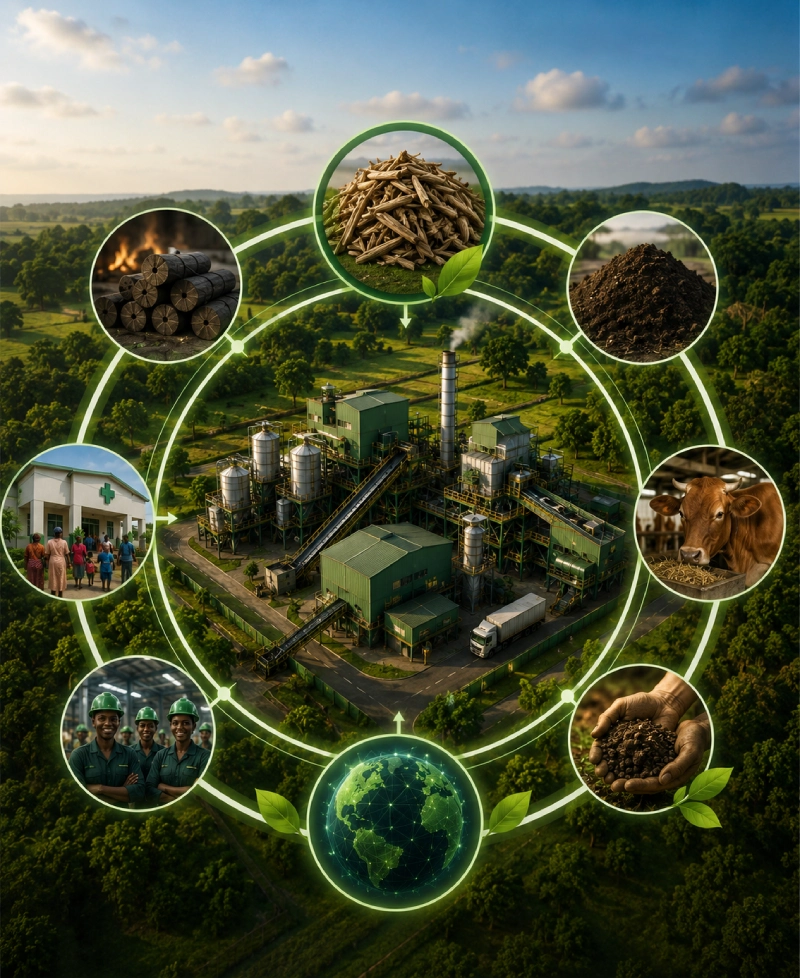
A circular industrial platform, by design.
Six revenue streams from one feedstock input. Healthcare, energy access, employment, and circular agricultural value built into the platform structure.
AGEL operates inside a closed industrial loop in Kakamega County, Kenya. Every output of the production process — the briquette, the residue, the fertiliser, the fodder, the credits — earns its place in the system. Community programs are not added to the platform; they are part of it.
Workforce commitment across all facilities. Aligned with 2X Challenge gender-lens criteria.
At full pipeline deployment. Direct displacement of charcoal and firewood demand.
Three primary, three secondary, three at the community engagement level.
Environment
County
Stakeholders
Frameworks
What does “circular by design” actually mean?
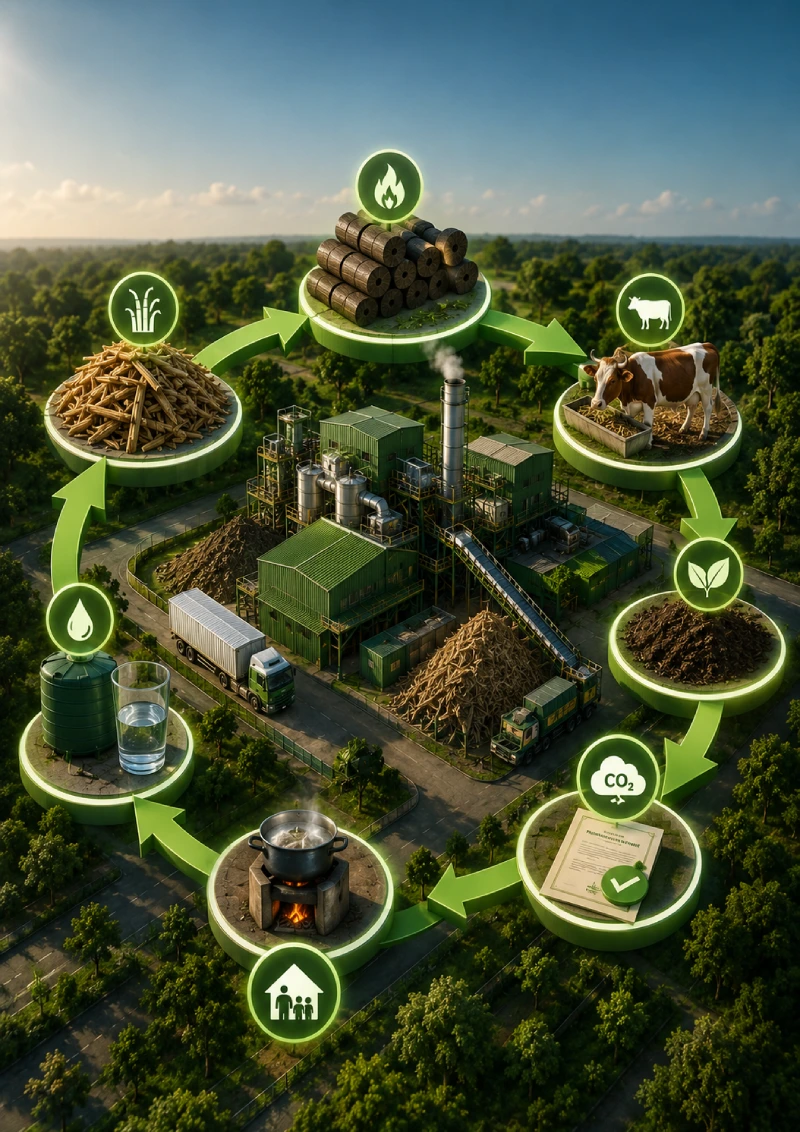
Six material flows enter and leave the AGEL facility, and every one is structurally accounted for. Sugarcane bagasse becomes briquettes. Production residue becomes cattle fodder. Process waste becomes organic fertiliser. Captured methane becomes credits. None of it is treated as waste.
Sugarcane bagasse from West Kenya Sugars and adjacent mills is dried, sized, and densified into industrial-grade briquettes that displace coal, wood, and heavy fuel oil.
Production residue and rejected briquettes are recovered as nutrient-balanced cattle fodder, distributed back to the farmers who supply feedstock and to surrounding livestock keepers.
Combusted ash and process by-products are converted into organic fertiliser and high-value foliar feed, returned to suppliers and to local agricultural cooperatives.
Methane that would otherwise escape from anaerobic decomposition is structurally avoided. Reductions are quantified under Gold Standard for the Global Goals (AMS-III.E methodology).
A portion of domestic briquette output is provided free to households in the immediate vicinity, displacing charcoal and reducing indoor air pollution from cookstove use.
Rainwater harvesting and on-site purification provide potable water for facility operations and surplus distribution to surrounding households as part of the circular service set.
What programs sit inside the platform?
Each program below is a designed feature of the Phase 1 facility, not a separate corporate-social-responsibility initiative running alongside it. Where Phase 1 design targets are stated, they are commitments made at the project planning stage; reporting will move to actuals once operations commence.
Employment
Local employment with gender commitment
Direct facility employment drawn from Kakamega County, with a workforce commitment of at least 50% women across all roles — production, operations, administration, and supervisory. Workforce structure aligned with 2X Challenge gender-lens criteria.≥50% women · Phase 1 commitment
Healthcare
On-site dispensary
An on-site dispensary providing diagnosis, consultation, and basic medication for AGEL employees, their families, and surrounding community members. Doctor-on-site model, with first-aid medication provided free of charge.Phase 1 design target
Clean Cooking
Free briquettes for nearby households
A portion of domestic briquette output is distributed without charge to households in the immediate vicinity of the facility, replacing charcoal and reducing indoor air pollution. Domestic cooking feedback informs ongoing product development.Approximately 50 households · Phase 1 design
Agricultural Returns
Free fodder & fertiliser to suppliers
Cattle fodder produced from rejected briquettes and process residue is distributed back to feedstock-supplying farmers. Organic fertiliser flows to the same farmers and to local cooperatives, supporting soil pH restoration in the catchment.Approximately 20 stakeholder farmers · Phase 1
Food Security
On-site canteen
A facility canteen providing nutritionally balanced meals at no charge to employees, with surplus capacity extending to community members during operating hours. Locally sourced where feasible.Approximately 50 meals daily · Phase 1 design
Knowledge & Engagement
Information centre
An on-site information centre providing access to the SCADA dashboard for community visibility, agricultural extension materials, and a structured channel for stakeholder feedback and grievance reporting.Continuous · Phase 1
What safeguards are built in across environmental and social dimensions?
Five domains of safeguard structure are integral to the platform design. Each is monitored via the SCADA-based Glass Box architecture, allowing continuous visibility for project developers, validators, and community partners.
Air Quality
Briquette combustion at the buyer end displaces wood and charcoal use, reducing both indoor and ambient air pollution. Particulate emissions from the production process are within limits established under the NEMA Environmental and Social Impact Assessment.
Water
Process water use is metered through SCADA, with discharge limits set during the ESIA. Surplus potable water from on-site purification is distributed to surrounding households.
Soil
Western Kenya soils have experienced acidification under conventional fertiliser use; AGEL's organic fertiliser stream contributes to long-term soil health restoration in the supply community.
Biodiversity
Social Risk
Project design follows IFC Performance Standards expectations for stakeholder engagement, labour and working conditions, and community health and safety.
How is the project monitored and verified?
At the core of AGEL is a proprietary industrial dMRV platform — a "glass box" architecture designed to give validators, verifiers, and buyers continuous visibility into the data underlying every issued credit.
Live process data flows from IoT-instrumented production stages into a tamper-resistant data layer. Feedstock intake, moisture, residence times, energy use, and output mass are captured at source rather than reconstructed from manual logs. The architecture is designed for eligibility under Gold Standard's dMRV Pilot Programme, the standard's framework for projects using digital monitoring to compress verification cycles and reduce per-credit MRV cost.
SDG 7
Affordable & clean energy
Substitution of charcoal, firewood, and fossil fuels with locally produced biomass alternatives.Primary
SDG 13
Climate action
Verifiable methane avoidance and fuel replacement reductions under a high-integrity standard.Primary
SDG 15
Life on land
Reduced demand pressure on Western Kenya's forest cover.Primary
SDG 5
Gender equality
Women's employment commitment of at least 50%; aligned with 2X Challenge.Secondary
SDG 8
Decent work & growth
Direct rural employment and feedstock-supply income to local agricultural communities.Secondary
SDG 12
Responsible consumption
Zero-waste model: every output of the production process earns its place.Secondary
SDG 3
Good health & wellbeing
On-site dispensary; reduced indoor air pollution from cookstove substitution.Community
SDG 6
Clean water & sanitation
Rainwater harvesting and on-site purification; surplus distributed to households.Community
SDG 11
Sustainable communities
Circular agricultural value flowing back to feedstock-supplying communities in Kakamega County.Community
How does AGEL report on sustainability performance?
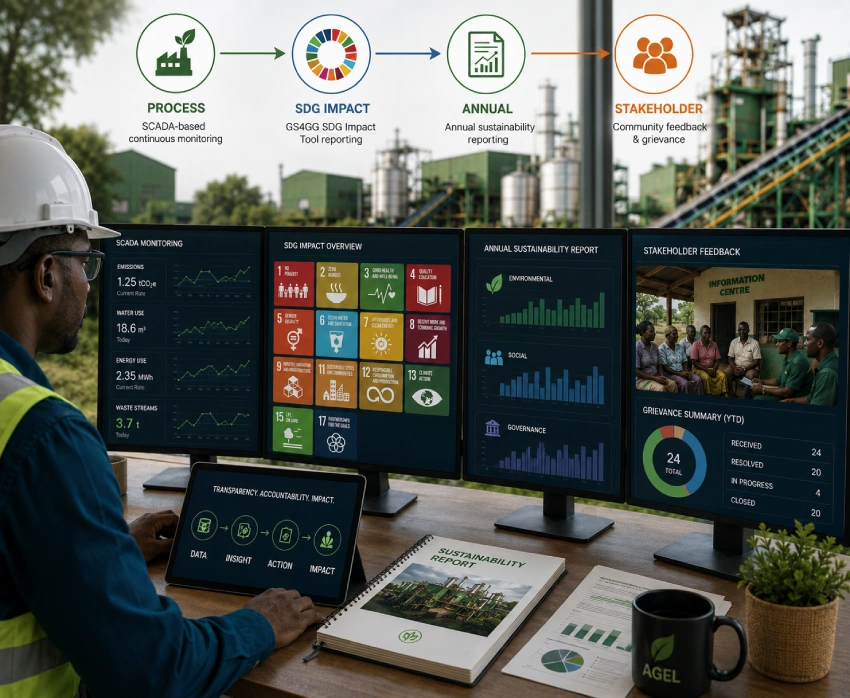
The Glass Box principle that governs the carbon project extends across the platform's environmental and social reporting. Process data, community programs, and SDG outcomes are tracked continuously and reported on a structured cadence.
SCADA-based continuous monitoring
Process emissions, water use, energy consumption, and waste streams are logged continuously at source via the SCADA architecture. Tamper-resistant data is accessible to validators, community partners, and project stakeholders on request.
GS4GG SDG Impact Tool reporting
SDG contribution is quantified using the Gold Standard SDG Impact Tool methodology and reported through the Gold Standard Impact Registry once Phase 1 is registered. Reporting frequency aligned with verification cycles.
Annual sustainability reporting
Annual reporting commitment covers environmental, social, and governance metrics across all operating facilities. Reporting structure is being designed for compliance with IFC Performance Standards expectations and IRIS+ indicators.
Community feedback & grievance
The on-site information centre serves as the primary stakeholder feedback channel. A structured grievance mechanism is being established in line with IFC Performance Standard 1 expectations. Reporting on grievances raised and resolved is part of the annual cycle.
Questions partners and journalists typically ask first.
AGEL’s platform structure includes local employment with a women’s commitment of at least 50%, on-site dispensary access for employees and their families, free briquettes for nearby households, free organic fertiliser and cattle fodder distribution to feedstock-supplying farmers, and rainwater harvesting infrastructure. These are platform features, not CSR overlays.
Stakeholder engagement is structured through an on-site information centre, continuous community feedback mechanisms, and a grievance channel designed in line with IFC Performance Standard 1 expectations. The Kakamega County Government has issued a Letter of Support confirming alignment with the County Climate Change Action Plan 2023-2027.
AGEL’s design is zero-waste: production residue is converted into cattle fodder and organic fertiliser. SCADA-based monitoring provides continuous tracking of process emissions, water use, and energy consumption. NEMA Environmental and Social Impact Assessment has been cleared. Forest pressure reduction is structurally embedded in the project’s design through the displacement of charcoal and firewood demand.
AGEL contributes primarily to SDGs 7 (clean energy), 13 (climate action), and 15 (life on land), with secondary alignment to SDGs 5 (gender equality), 8 (decent work), and 12 (responsible consumption). At the community engagement level, additional contributions map to SDGs 1, 2, 3, 6, and 11.
SCADA-based digital monitoring provides continuous visibility on process metrics. SDG impact is reported through the Gold Standard SDG Impact Tool methodology. Annual reporting commitments cover environmental, social, and governance metrics across all facilities once Phase 1 commences operations.
Working with the platform on sustainability
AGEL welcomes enquiries from CSR procurement teams, foundations and grant-makers, community partners, journalists, and researchers. Specific commercial information is shared under non-disclosure on request.
"From waste to energy. From energy to climate assets."
Track A — CSR & Procurement
Corporate sustainability procurement
For corporate procurement teams sourcing high-integrity carbon offsets, briquette supply with documented social co-benefits, or partnership opportunities with verifiable community impact stories.info@alkebulan.energyTrack B — Foundations
Grant-makers & ecosystem partners
For foundations interested in supporting circular-economy infrastructure, women's economic empowerment, clean cooking access, and rural agricultural value chains in East Africa.info@alkebulan.energyTrack C — Community
Local partners
& suppliers
For Kakamega-based farmers, agricultural cooperatives, healthcare providers, and educational institutions seeking partnership through the Phase 1 community programs.info@alkebulan.energy