
Carbon Project
Western Kenya
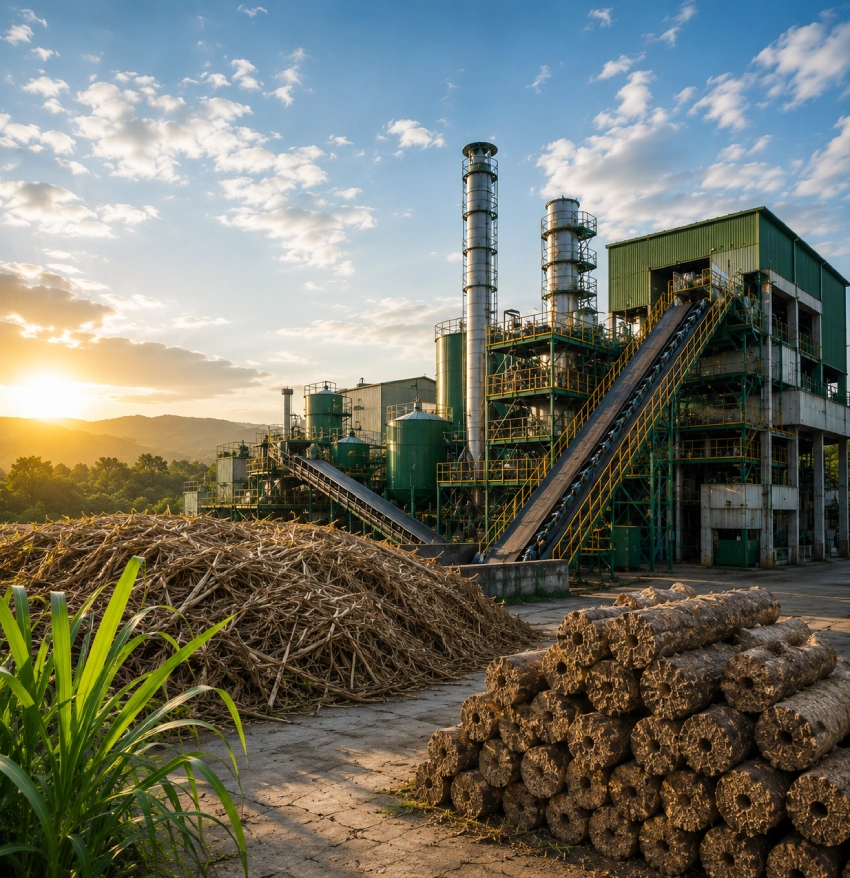
Verified emission reductions from sugarcane bagasse, developed under Gold Standard for the Global Goals.
A proprietary industrial dMRV platform for multi-stream emission reductions.
Alkebulan Greens Energy diverts sugarcane bagasse from anaerobic decomposition in Kakamega County and converts it into densified briquettes that replace wood, charcoal, and fossil fuels. Two parallel emission-reduction streams — methane avoidance and fuel replacement — are being developed under Gold Standard for the Global Goals (GS4GG), with monitoring delivered through SCADA-based digital MRV.
~40,000tCO₂e/yr
Methane avoidance + fuel replacement, single facility commissioning
~161,000 tCO₂e/yr
Eight planned facilities across East Africa at full deployment
2 streams
Methane avoidance + fuel replacement under Gold Standard for the Global Goals
Standard
Mechanisms
Monitoring
Country
How does the project reduce emissions?
Sugarcane milling in Western Kenya produces large volumes of bagasse — the fibrous residue that remains after cane is crushed for sugar. A significant portion of this material is left to decompose in open piles, where anaerobic conditions release methane, a greenhouse gas with global warming potential approximately 28 times that of CO₂ over a 100-year horizon.
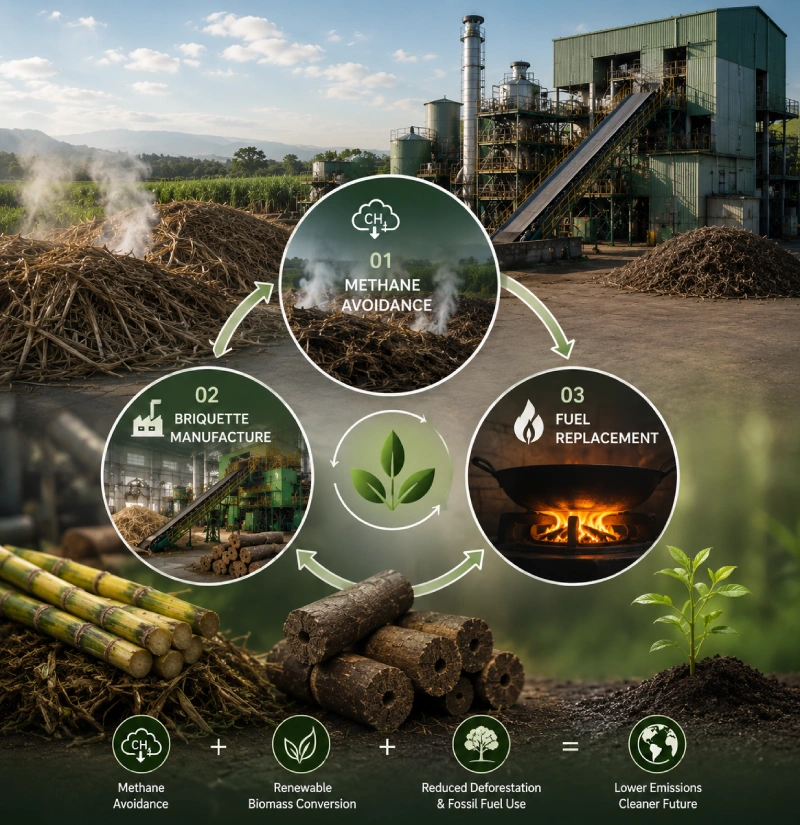
AGEL diverts that bagasse into a controlled industrial process and converts it into densified briquettes used as a clean-burning fuel for industrial boilers, institutional kitchens, and household cooking. The project generates emission reductions through two distinct, additive streams:
Methane avoidance
Bagasse is removed from open dumping or stockpiling before anaerobic decomposition begins. The methane that would otherwise be released into the atmosphere is structurally avoided.
Briquette manufacture
Bagasse is dried, sized, and densified at AGEL’s facility under SCADA-controlled conditions. Production residue is recovered as cattle fodder and organic fertiliser.
Fuel replacement
Briquettes displace wood, charcoal, and fossil fuels at the point of combustion. Buyers reduce their own scope-1 emissions and regional pressure on forest cover declines.
The two streams operate on different gases (CH₄ and CO₂), at different points in the value chain, and against different baselines. They are independently quantified and do not double-count.
What standard governs the credits?
The project is being developed under Gold Standard for the Global Goals (GS4GG), the integrity benchmark for voluntary carbon credits established by WWF and partners. Gold Standard credits are recognised for their rigorous additionality testing, mandatory SDG co-benefit requirements, and alignment with the Core Carbon Principles framework.
AGEL applies internationally recognised methodologies for methane avoidance from biomass diversion and for fuel replacement at the point of combustion. Together they capture the two distinct emission-reduction streams the project generates. Specific methodology selections, baseline parameters, and ex-ante volumes are documented in the Project Design Document and supporting technical memoranda.
Standard
Gold Standard for the Global Goals
Voluntary carbon standard with mandatory SDG impact reporting, robust additionality testing, and registry transparency. Established 2003; current GS4GG framework adopted 2017.Mechanisms
Methane avoidance + Fuel replacement
Two emission-reduction streams under recognised Gold Standard methodologies: avoided methane from biomass decomposition, and displacement of higher-emission fuels at the point of combustion.Verification
Independent Validation & Verification
All claimed reductions are subject to validation and verification by an accredited independent body (VVB) before any credits are issued. AGEL's digital MRV is purpose-built to support this process.What is the projected scale of emission reductions?
AGEL’s emission-reduction footprint scales in two stages: a single commissioned facility serving the immediate Kakamega catchment, and a regional pipeline of eight facilities at full deployment.
Note on figures. Volumes shown are projected ex-ante estimates based on the current Project Design Document and the conservative parameter defaults applied under the relevant Gold Standard methodologies. Actual issued credit volumes will be determined post-validation and post-verification by an accredited Validation/Verification Body (VVB), and may differ from projections.
Initial Scope
~40,000tCO₂e / year
Single-facility commissioning. Combined methane avoidance and fuel replacement.Pipeline Target
~161,000tCO₂e / year
Eight planned facilities across East Africa at full deployment, leveraging shared SCADA/dMRV infrastructure and standardised PDD architecture.
How is the project monitored and verified?
At the core of AGEL is a proprietary industrial dMRV platform — a "glass box" architecture designed to give validators, verifiers, and buyers continuous visibility into the data underlying every issued credit.
Live process data flows from IoT-instrumented production stages into a tamper-resistant data layer. Feedstock intake, moisture, residence times, energy use, and output mass are captured at source rather than reconstructed from manual logs. The architecture is designed for eligibility under Gold Standard's dMRV Pilot Programme, the standard's framework for projects using digital monitoring to compress verification cycles and reduce per-credit MRV cost.
Process variables logged at source via SCADA. No manual reconciliation gap.
Data layer designed for VVB and standard-body inspection on demand.
Reduced field-team and lab-cost burden across the project’s crediting period.
Digital evidence shortens the validation site-visit and verification cycle.
What else does the project deliver?
Gold Standard requires demonstrated and quantified contribution to the UN Sustainable Development Goals beyond the headline emission reduction. AGEL's project is designed to deliver across four primary SDGs, with reporting integrated into the GS4GG SDG Impact Tool.
Substitution of charcoal, firewood, and fossil fuels with a clean-burning, locally produced biomass alternative.
Verifiable methane avoidance and fuel-replacement reductions under a high-integrity standard.
Reduced demand pressure on Western Kenya’s forest cover, which has fallen below regional sustainability thresholds.
Additional outcomes include local employment in Kakamega County, reduced indoor air pollution where briquettes replace charcoal in cookstoves, and reduced open burning of agricultural residues in the broader sugar-belt landscape.
Working with the project
AGEL welcomes enquiries from carbon project developers, standards bodies, forward-credit buyers, and offtake partners. Specific commercial information is shared under non-disclosure on request.