Why Us?

Proprietary Industrial Biomass Platform Kenya
Biofuel production at Alkebulan Greens Energy is engineered, automated, and built for scale. A proprietary industrial biomass platform converts locally sourced agricultural residue into high-efficiency industrial fuel — supplied across manufacturing, institutional, and household sectors in Kenya.
- Activated biomass briquettes are manufactured using proprietary automation technology. Every tonne produced diverts agricultural waste from landfills and open burning, delivering high-efficiency industrial fuel to factories, institutions, and households across Kenya.
- Renewable biomass fuel diverts agricultural waste from landfills, reduces carbon emissions, and preserves forest cover. Every briquette produced replaces firewood and charcoal – at a lower cost per unit of heat delivered and a measurably lower carbon footprint.
- Every facility produces clean energy and builds the community surrounding it. Local hiring, deliberate skills training, and ≥50% women’s employment across all facilities are embedded into every operation. Medical care, meals, and potable water are provided to employees and surrounding communities as standard. Clean energy and community development – engineered into the same platform.
Built at Scale. Running at Capacity.
Production capacity: 1,500 MT per month. Industry average: 400 MT per month. The difference is structural, not incremental. The facility operates 24/7 via remote automation - every stage from raw material intake to packaged output is monitored in real time. Consistent quality, uninterrupted supply, and recorded downtime across every production cycle.
Agro-Industrial Infrastructure. Built for Scale.
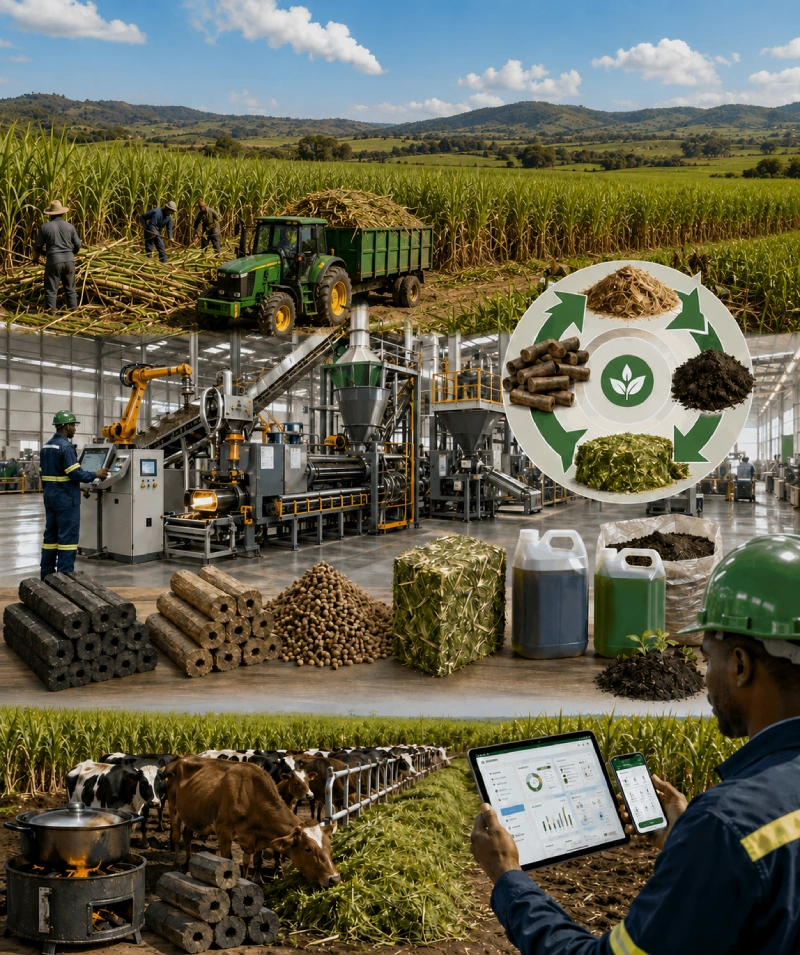
Kenya is an agrarian economy. Every facility sits within its supply chain – sited close to sugar factories, agro-processing hubs, and smallholder farms. Raw material is local, consistent, and low-cost. The technology is proprietary, registered, and operational. The production model runs at 98% material utilisation within a closed circular economy – feedstock not converted into fuel is engineered into cattle fodder or organic fertiliser. Every input generates a return.
- Biomass briquettes, cattle fodder, and organic fertiliser – all produced and priced for Kenya’s industrial and agricultural markets. Every tonne of fuel dispatched preserves over 200,000 trees per year by replacing firewood and charcoal as primary fuel sources – at full deployment.
- Within a circular economy model, all production residue across Kenya is converted into cattle fodder and organic fertiliser. Every kilogram of raw material processed generates a sellable product. Zero to landfill
- The multi-stream revenue biomass platform generates income across six integrated product lines and distinct markets. Activated industrial briquettes. Domestic briquettes. Export pellets. Cattle fodder. Organic liquid fertiliser. Organic solid fertiliser. Each product line serves a defined market segment – collectively strengthening the platform’s revenue structure and resilience.
- Every stage of production is automated – from raw material intake to packaged output. Order-to-delivery is managed through a custom web and mobile application.
- Raw materials are sourced from local farmers. Finished products are returned to the same communities. Agricultural residue that enters the facility as waste leaves as fuel, fertiliser, and fodder – back to the people who supplied it.
- Employment is local. Training is deliberate. Women represent ≥50% of the workforce across all facilities – hired, skilled, and fairly compensated as a standard. Every person who works at Alkebulan develops capabilities that extend beyond the operation.
- On-site medical facilities, food canteens, and potable water infrastructure are provided to employees and surrounding communities as standard. Operational commitments – funded, delivered, and maintained annually.
- Cattle fodder and organic fertiliser are produced directly from production residue – supplied to Kenya’s farmers, cooperatives, and agro-dealers. Fodder is formulated to increase milk yield. Fertiliser is engineered to rebuild soil health.