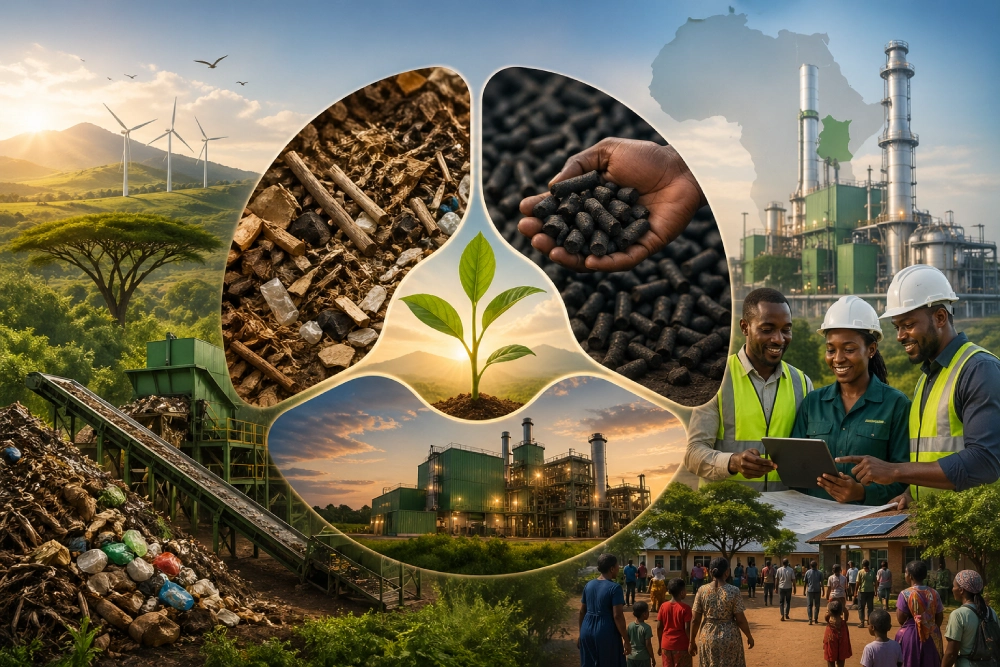
East Africa's Industrial Biomass Infrastructure

East Africa's Industrial Biomass Infrastructure

Transitioning a continent requires more than ambition. It requires industrial discipline. At Alkebulan Greens Energy, we build waste-to-value infrastructure designed for scale across Kenya and East Africa. Decades of cross-sector experience underpin every facility we engineer, every feedstock supply chain we secure, and every revenue stream we activate. Progress is measured in tonnes of CO₂ avoided, trees preserved, and communities powered. The target outcome is an East Africa where no industry depends on firewood, coal, or heavy fuel oil to function. Our work stands on three pillars:

Agricultural residue enters our supply chain as raw material and exits as high-efficiency industrial fuel. Automated, precision-engineered processes convert sugarcane bagasse and agroforestry waste into activated biomass briquettes – supplied to factories, institutions, and households across Kenya.

Our fuels are measured, not marketed. Briquette produced avoids ~20,000 tCO₂e per year – methane, single facility – and preserves over > 200,000 trees annually from deforestation. Renewable biomass fuel replaces firewood and charcoal, priced for industrial scale and accessible across Kenya.

Local communities supply our raw materials. Local people staff our operations. Every facility returns value to its source – affordable fuel, organic fertiliser, cattle fodder, and employment. The circular economy model is not a production concept alone. It is a contractual relationship with every community we operate in. Women form the core of every operation – hired, trained, and fairly compensated across all levels, from raw material sourcing to production to distribution. ≥50% women’s employment across all facilities – a target and a commitment.

We Transform Waste into Value.

Agricultural waste enters our supply chain as industrial fuel, organic fertiliser, and cattle fodder – fully converted, nothing discarded. Every tonne processed reduces deforestation pressure and eliminates open burning. Economic growth and environmental restoration are engineered into the same process, by design.

Waste Intercepted. Value Created.

Agricultural residue has two destinies - a landfill or a fuel. Sugarcane bagasse and agroforestry waste that would otherwise burden Kenya's waste infrastructure is intercepted, processed, and converted into high-efficiency activated biomass briquettes. The waste problem and the energy problem, resolved by the same industrial process.

High Performance. Lower Cost.

Raw materials are locally sourced, abundantly available, and consistently priced. Sugarcane bagasse and agroforestry residue form the foundation of a supply chain insulated from global fuel price volatility. The result: biomass briquettes that outperform firewood, coal, and heavy fuel oil at a lower cost per unit of heat delivered. Standardised plant design and automated process control ensure the model scales from the first facility to the eighth.

Value That Stays in the Community.

The circular economy model delivers measurable community impact across Kenya — a contractual relationship with every community we operate in Farmers who supply raw materials receive affordable fuel, cattle fodder, and organic fertiliser in return. Workers receive fair wages, skills training, and access to medical facilities. Value generated at every facility flows back to its source - completing the circle, by design.

Women at the Centre.

Women are hired, trained, and fairly compensated at every level of operations - from raw material sourcing to production to distribution.≥50% women's employment across all facilities in Kakamega and beyond — a direct investment in women's economic empowerment, a commitment embedded into every facility we build. Skills developed at Alkebulan are transferable, career-building, and designed to extend beyond our operations.

Waste Intercepted Before It Reaches the Ground.

Climate mitigation is the production output - measured in every tonne of waste intercepted before it reaches a landfill. Facilities are deliberately sited near sugar factories and agro-processing hubs, securing a consistent, low-cost supply of sugarcane bagasse and agroforestry residue at source. The raw material is local, abundant, and structurally available across the supply chain.

Engineered for Consistency. Built to Scale.

Every facility runs on automation - from raw material intake to packaged output. Each stage is remotely monitored, consistently executed, and quality-verified before dispatch. Standardised plant design eliminates process variation and manual bottlenecks, ensuring output consistency across every facility in the pipeline.

Community as Partner. Value as Proof.

Every facility is built within a community, not alongside one. Every person within the impact radius is a stakeholder - supplied with affordable fuel, employment, skills training, and access to medical facilities. Success is measured in livelihoods improved alongside every tonne of clean fuel dispatched. Women are central to that measurement - hired, trained, and fairly compensated at every level of every operation.
Journey

Verified. Certified. Trusted.

Operations are independently verified against confirmed compliance milestones. Credentials are earned, not declared.

NEMA Environmental and Social Impact Assessment.

Kakamega County Letter of Support.

Gold Standard for the Global Goals (GS4GG) — Methodology selected for biomass carbon credits in Kenya
Proprietary platform architecture.

Infrastructure quality and compliance speak before awards do.

Verified. Certified. Trusted.
Briquettes Demand
80M+
MT/Yr